
From the day I brought it home, I knew that the brakes on the eclipse…. weren’t great. The car suffered from pretty severe brake drag at several wheels, and was still sporting its original rubber brake lines. Oh boy.
My shopping list started out with stainless brake lines and caliper seal kits for all four wheels, sounds easy! Sadly, that won’t be the last of the expenses. (Don’t worry, it doesn’t get too bad). Before starting this work, I had to bring the eclipse back from a friend’s garage where it had been staying while I made space to keep it in my own. On that drive, which was the longest the car had been on since I got it home, the brake drag issue became apparent. Both of the front brakes were constantly dragging with at least 5% pressure as well as one rear. While this didn’t make the car impossible to drive, it did slow it down. Ohh, and it meant that the brakes got INCREDIBLY hot. I knew things weren’t going great when I could smell the burning pads halfway home and I already began to feel the rotors warping more and more with every mile. Add new rotors to the shopping list.
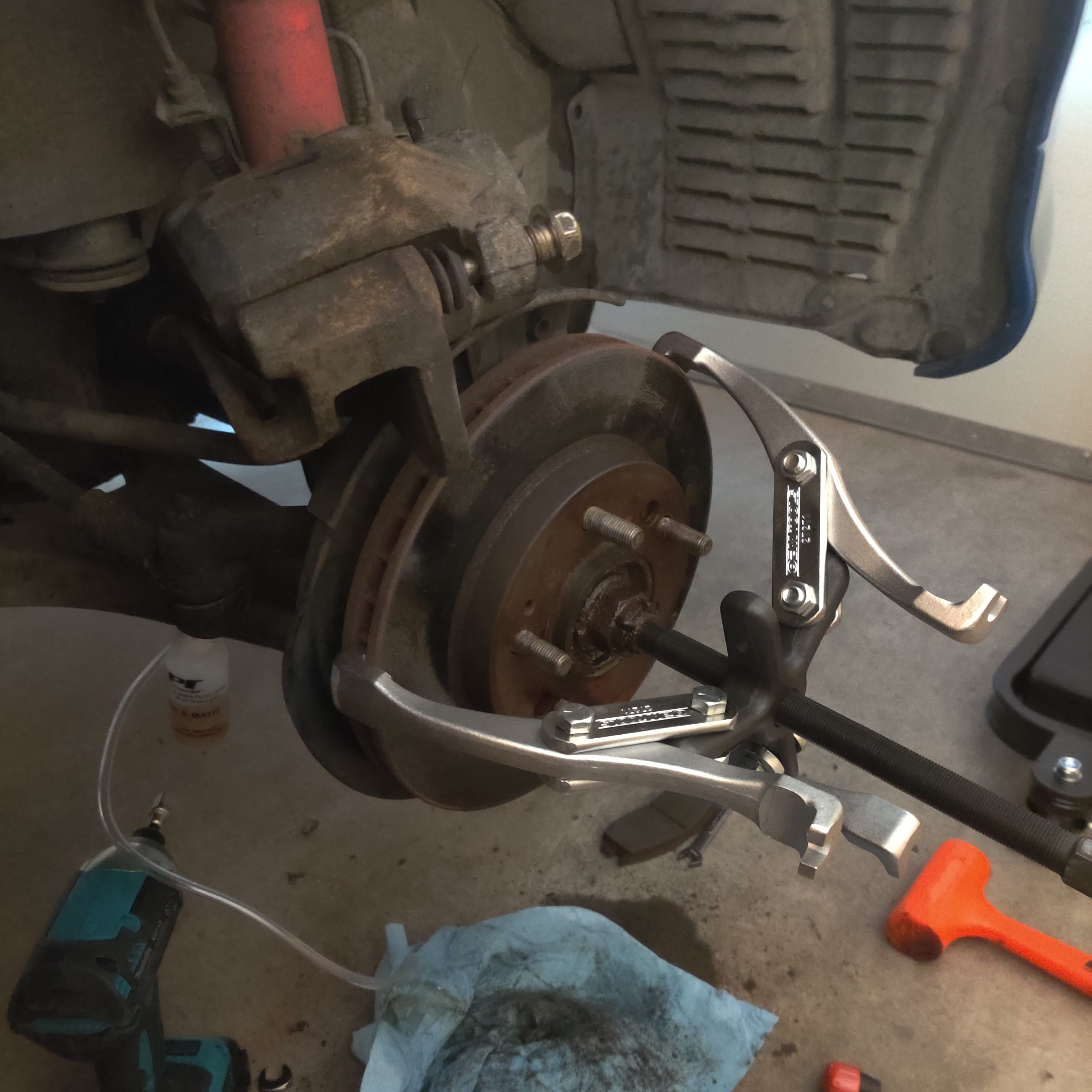
When I first got the car in the air, I immediately began pulling the front brakes off. A task I’ve done a good many times by now, I was prepared to have the car ready for new parts in a single afternoon. What I wasn’t prepared for, was just how bad the rotors had warped from the heat of that drive home. Now, both front rotors were firmly seized onto their hubs with an unfathomable pressure due to them losing their shape. Fortunately, the nearest auto parts store had a massive pulley extractor they were willing to let me borrow. Unfortunately even with this, I wouldn’t be able to muscle up the torque to break the rotor free.
This story has a happy ending though. My best idea at this point was to soak the hub in penetrating oil, torque the extractor onto the hub as tightly as I could manage, and walk away. “Maybe it will eventually just come free!” I thought, and incredibly that’s exactly what happened with both wheels. So with a little patience, the front brakes were apart and ready for the rebuild.
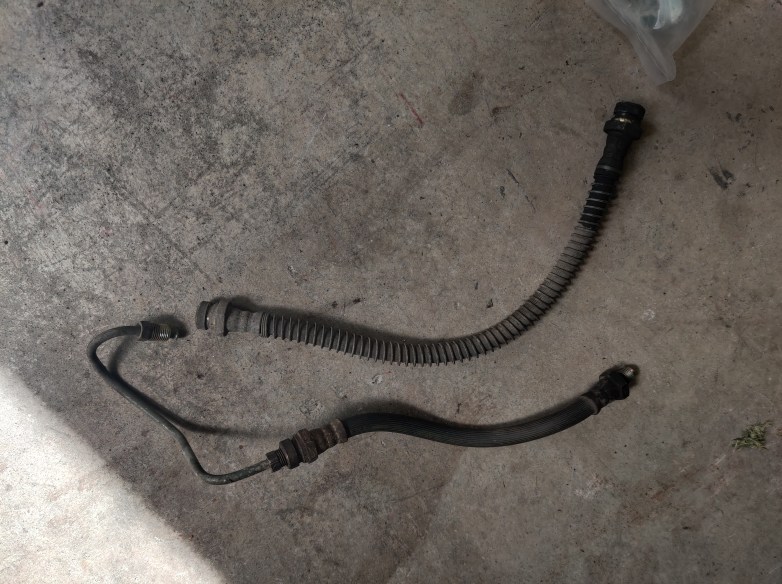
A little sidenote about the brake lines that someone engineer cooked up in the late 80s at Mitsubishi. At each wheel, the eclipse has not one brake line, but 3 at each front and 2 at each back. They appear to employ a design where one soft line section goes form the wheel arch to the suspension, which is responsible for accommodating suspension travel. Then, it either meets another soft line at a bracket (rear), or it joins a short section of hard line (front) before connecting to another soft line. This lower section is then only responsible for accommodating the motion of the wheel turning (in the case of the front wheels). Why this was chosen over a single line that would flex as necessary under both turning and suspension travel, I have no clue, perhaps it has to do with where the line meets the caliper? I can say that after plenty of research, I found that Mitsubishi abandoned these brakes entirely just as fast as they abandoned the pop-up headlights.
This fact actually caused me a good bit of headache when buying the parts for this work. I learned that for the first 2 years of the eclipse, the GSX and GS were equipped with the same brakes. Then, when the 1G eclipse got its facelift, it silently got bigger rotors and different calipers. Every parts database on earth though, seems to have lost this information and so if you attempt to buy brake parts for a pre-facelift GSX, you’ll be sold parts to fit a post-facelift GSX. The only way to get the correct rotors then, was to order brake rotors for a 1G eclipse GS. While this fact did cause me to have to buy and exchange a set of rotors, it’s hardly an inconvenience.
Now, let’s talk calipers.
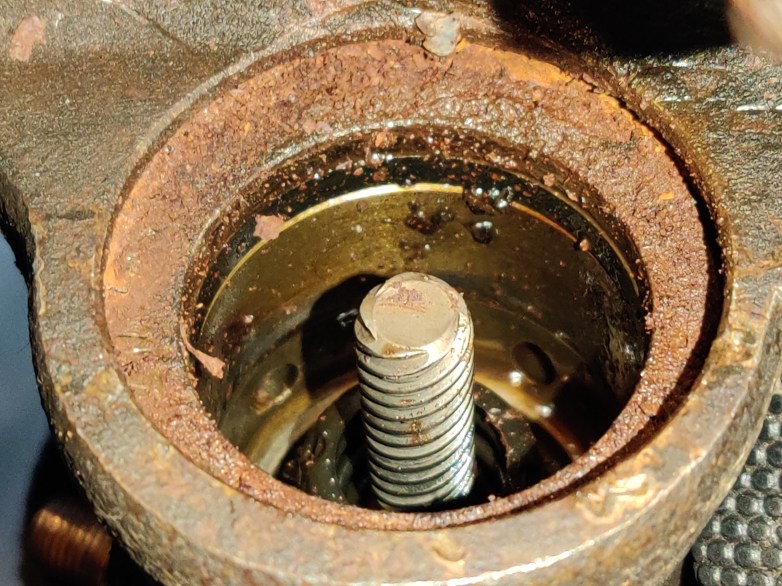
While I originally intended to rebuild all four calipers on the car, I eventually decided that I’d rather replace the fronts with remanufactured OEM calipers since it’s the kind of work I’ve never done before. Honestly, I would have done all four this way however I couldn’t find any remanufactured rear calipers at the time. The front calipers showed up quickly with new hardware and they took just a fraction of an afternoon to slap on complete with the new, correctly sized rotors and a set of pads and get the system bled.
The rear calipers were a different story. Originally I only planned to do the front brakes when I thought that all the brake drag was happening at the front of the car, but after taking a drive with the new front brakes and old rears, I could easily tell that while almost all of the brake drag was gone, it wasn’t all gone. While I still couldn’t get my hands on remanufactured rear calipers, I did still have the rebuild kit that I had originally picked up, so rebuild them I did.
I wish I had taken more pictures of this process, but I just got to doing it one day and before I knew it, I had finished the job. It involved pulling apart the calipers and giving them an initial brushing before letting them spend an hour in an ultrasonic cleaner. I went back over the exterior of the caliper with a steel brush for a good while before re-greasing and assembling everything. The eclipse parking brake mechanism is integral to the rear calipers, which gave them some added complexity and required me to go out and buy a special set of long reach snap ring pliers to get them back together, but all worked out. The rears went back together just as easily as the fronts, although I chose to keep the old rotors for now as they didn’t end up warping like the fronts. One more brake bleed and a test drive later, the car rolls as free as can be.
This brake job marks the end of the initial work I have planned for the car prior to its engine rebuild, so it’ll be lying in wait until it’s time to get that started. I expect the process to take quite some time beyond just the rebuild and reseal. I want to give the block a thorough cleaning and I’m ready to have the it leveled and honed at a machine shop if it’s too far out. Beyond that, I plan on measuring the cylinders and bearing surfaces to get oversized rings and bearings to take up any slack. Otherwise, it’ll probably get new ones at spec just for peace of mind. Beyond that, new gaskets, seals, belts and pulleys await the car, as well as a new clutch and water pump. I’ll probably give the oil pump a once over too while it’s apart, but I have no plans to replace it.
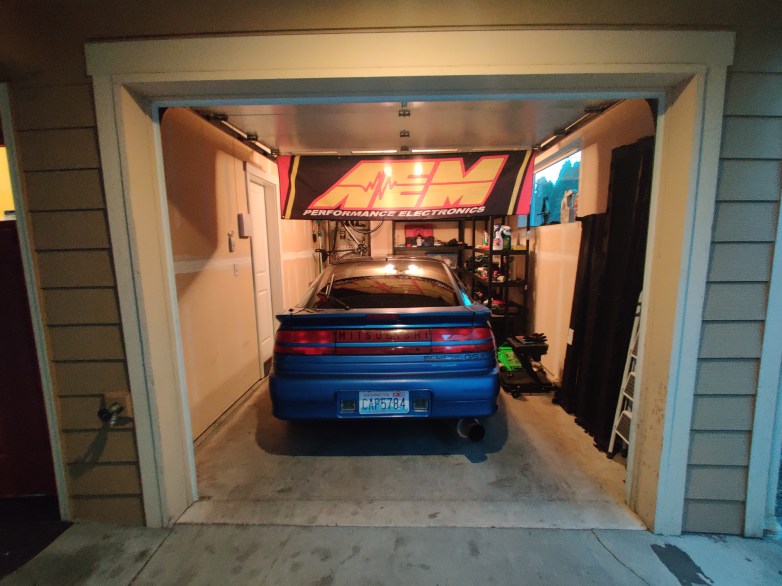

 My 1990 Mitsubishi Eclipse GSX Project