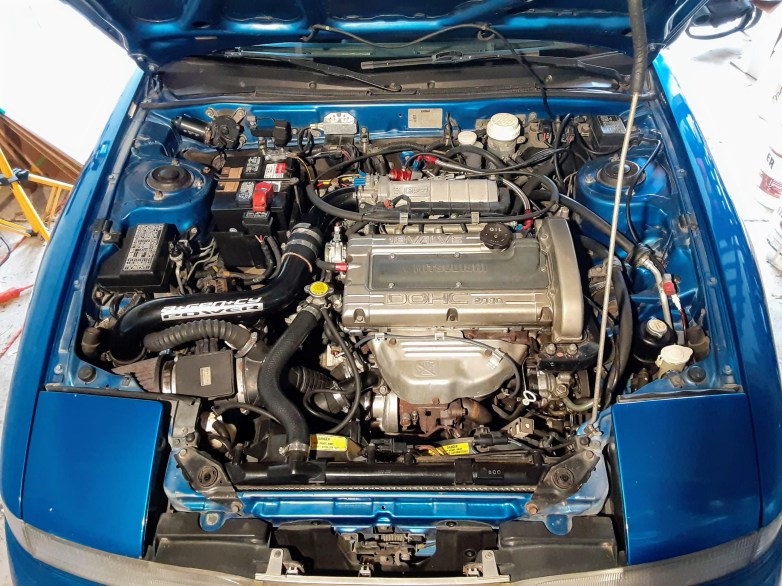
Buying a car that someone else has modified is a risky venture. There’s no guarantee that they’ve done what they say they’ve done, or more importantly, that they’ve done it well. I knew the risk I was taking when I got this car and it’s critical that I find and understand exactly what has been done and how well it’s bene done.
The car has a short list of modifications that have been installed… Beyond the simple ones like an Agency Power charge pipe, Megan Racing suspension braces (not pictured), and 3.5″ Megan Racing turbo-back exhaust, an upgraded fuel pump, regulator, and injectors have been installed, and an Apexi S-AFC 2 is wired in to control them.

Cars of a fine vintage such as this one were much electronically simpler than modern vehicles. This is one of the many reasons that a car from this era makes such a good project. When replacing parts like injectors and regulators to deliver more fuel, a modern car would have it’s ECU programmed with a new fuel delivery curve to do just that, take advantage of the new parts and deliver more fuel. The brain of the GSX is much simpler though and the tune is written into a programmable memory chip that sockets onto the board. The AFC offers a workaround by tapping into the car’s harness where it connects to the ECU and intercepting the signal from the airflow sensor. The module can then modify the signals sent to the ECU to trick it into doing things like delivering more fuel. This one is also receiving airflow measurements from a MAF sensor taken from a later generation eclipse that was fitted into this car.
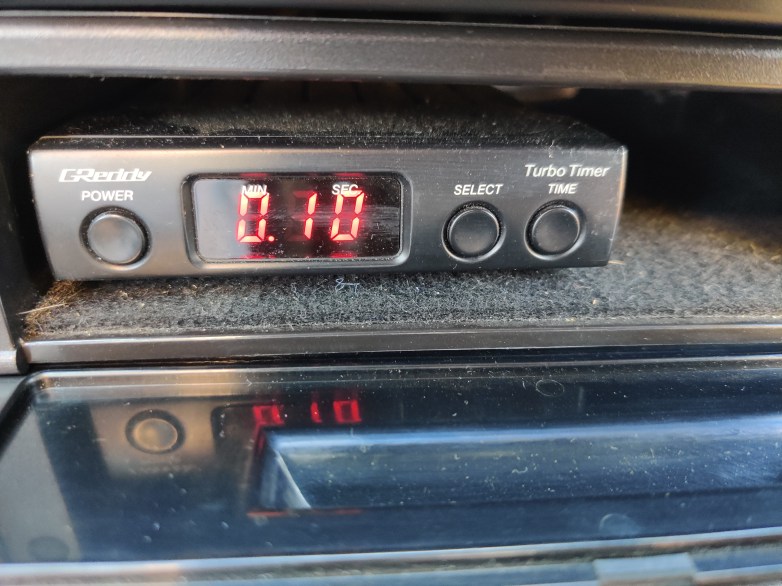
Another piece of tech support that this car receives comes in the form of this Greddy turbo timer. The GSX is equipped with an oil cooled turbo, meaning that unlike modern cars, coolant isnt used to reduce the turbo’s temperature. Instead, it relies on the flow of oil from the lubrication system to draw heat away from the unit. Normally this isn’t an issue (this turbo has been working fine for 3 decades!) however there is a risk of damage if the car is driven hard and then quickly shut off. While coolant would continue to flow to a modern turbo at this point, the oil immediately stops flowing and this car’s turbo is left to sit and smolder, which can be damaging.
The turbo timer wires into the ignition harness and the ECU and keeps track of how long the car has been running and how hard its being driven. Then, when the car is shut off, the turbo timer begins to play a cheerful little song while it counts down from whatever time it has decided the car should run for. The timer ensures that the car sits at idle RPM, keeping the oil pump running without battering the turbo with hot exhaust gas so that the circulating oil can help it cool down before turning off.
Once the timer reaches zero, the car shuts off as usual with the turbo safely cooled. The idea behind the turbo timer, I guess, is that you can take your keys, lock the car, and go into the store and let the car cool itself down and shut off. In reality though, all you need to do is remember to let the car idle for a few minutes before shutting it off after getting it all heated up. Plus, leaving the car unattended while it idles in neutral isn’t something I’m crazy about. While it isn’t a critical piece of tech in the car, it does at least remind you to let it cool down when you remove the key and the car doesn’t stop running. Plus, who could resist a little computer that plays you a song when you get out of the car?

 My 1990 Mitsubishi Eclipse GSX Project